Have you ever wondered how many reps are ideal for muscle growth—5, 10, or maybe 15+? Let’s break it down using both science and real-world gym experience on how to use rep ranges to maximize gains.
What Is Hypertrophy?
Hypertrophy is the scientific term for muscle growth. In physiology, it refers to an increase in the cross-sectional area of muscle fibers, not because you add more fibers (that’s hyperplasia), but because each existing fiber gets thicker.
This happens through a cycle of stress and repair:
- Tension: You lift a load heavy enough to challenge your muscles.
- Damage: Microscopic tears occur inside the fibers.
- Repair: The body repairs and reinforces those fibers through protein synthesis, making them stronger and larger.
The Classic Repetition Continuum
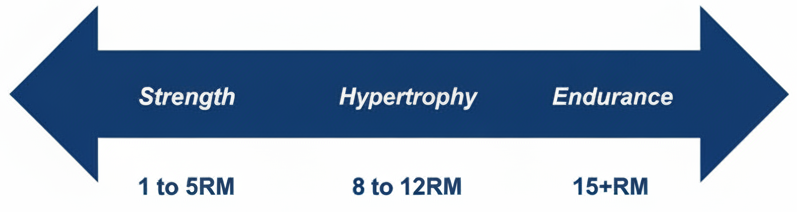
For decades, strength scientists and coaches used what’s called the repetition continuum—a model that connects rep ranges with specific physical results. It looks like this:
- Low reps (1–5) at 85–100% 1RM: Focused on maximal strength and power.
- Moderate reps (6–12) at 70–80% 1RM: Optimal for hypertrophy (muscle growth).
- High reps (15+) at <60% 1RM: Target muscular endurance and stamina.
Your 1RM (one-rep max) is the heaviest load you can lift once with perfect form. For example, if your bench press 1RM is 200 pounds, 160 pounds would be 80% of your 1RM—roughly the weight you’d use for 8–10 reps.
This continuum made programming easy: train heavy for strength, moderate for size, light for endurance.
Two classic resistance-training studies helped cement the idea that different rep ranges lead to non-overlapping adaptations in strength, size, and endurance. Early work by Anderson and Kearney (1982), followed by Campos and colleagues in 2002, compared groups training with low reps and heavy loads, moderate reps with moderate loads, and very high reps with light loads over several weeks.
The heavy-load, low-rep groups showed the greatest increases in maximal strength, the moderate-load groups experienced the largest gains in muscle cross-sectional area, and the light-load, high-rep groups improved muscular endurance and fatigue resistance the most.
A New Era of Research: Challenging the Old Model
A landmark 2016 study led by Brad Schoenfeld compared low-load training (25–35 reps) with high-load training (8–12 reps) to failure. Surprisingly, muscle growth was nearly identical when total volume and effort were matched—though strength gains were higher in the heavy group.
Since then, multiple reviews have supported these findings. A 2021 meta-analysis concluded that hypertrophy can occur across 5–30 reps, as long as:
- You train close to failure (within 0–3 reps).
- Total weekly training volume is equal.
This means the hypertrophy “zone” isn’t a narrow 6–12 window—it’s a flexible range that depends on intensity, proximity to failure, and volume management.
Why the 6–12 Range Still Dominates
If growth happens with both heavy and light loads, why do most lifters still stick to 6–12 reps?
Because it’s the most efficient range for balancing fatigue, tension, and time.
Here’s why:
- Heavier loads (1–5 reps) produce great tension but burn out your nervous system fast.
- Lighter loads (20–30 reps) cause extreme fatigue and burn, but you spend much longer per set reaching failure.
- Moderate loads (6–12) land in the sweet spot—strong enough to create mechanical tension, long enough to build metabolic stress, and sustainable for multiple productive sets.
In practice, that makes this range ideal for hypertrophy blocks, especially for people who are not professional powerlifters or endurance athletes.
Load vs. Effort: Why “Near Failure” Is Crucial
Whether you’re using 5 reps or 20 reps, effort is everything.
Muscle fibers are recruited in a specific order—from small endurance fibers (Type I) to large, growth-prone fibers (Type II). According to the size principle, you only achieve full recruitment when you approach muscular failure.
That means:
- A heavy 5-rep set near failure can recruit all fibers.
- A 20-rep set can also recruit them all—but only at the end, after extreme fatigue.
High-Repetition Training: When and How to Use It
Light-load, high-repetition training (15–30 reps) isn’t just for endurance athletes—it can be a powerful hypertrophy tool when used strategically.
The key is pushing each set to true failure, since lighter weights won’t fully recruit high-threshold muscle fibers otherwise.
Benefits of high-rep work:
- Increases local muscular endurance.
- Enhances capillary density and nutrient delivery.
- Great for pump-based or “finisher” sets.